

Canada’s screen industry is under pressure, but there are practical ways to help move solutions forward. From writing to elected representatives and signing the federal grind petition to supporting “Keep Ontario Rolling” and DGC National’s “Canadian Stories. Global Impact.” campaign, the CPD is calling on our community to get informed, get involved, and get loud.
Canada’s film and television industry has been under enormous pressure.
A prolonged production slowdown, economic uncertainty, changing financing and commissioning models, rapidly evolving technology, international competition, and ongoing uncertainty around trade and tariffs have all contributed to an industry where too many projects remain stalled and too many people are going too long between jobs.
At the same time, the business itself has contracted. Studios and streamers are commissioning fewer projects, consolidation has reduced the number of buyers in the marketplace, and traditional television — historically an important source of financing and commissions for Canadian programming — continues to lose audiences and advertising revenue as viewing shifts online. The result is fewer greenlights and greater competition for the projects that do move forward.
We are also seeing increased pressure on wages, working conditions, and established protections. In a difficult employment market, some productions are trying to drive rates and conditions downward. A slowdown should not become an excuse to undervalue experienced crew or weaken the standards that make this a sustainable profession.
There is no single fix, but there are some concrete solutions already on the table — and we must help move them forward.
Our unions, guilds, industry associations, producers, film offices, and other organizations are already doing that work: advocating for stronger production incentives, greater investment in Canadian content, fair working standards, and policy changes that can strengthen the screen sector.
The CPD stands firmly in alignment with those efforts. We are also seeking meetings with elected representatives as we speak to make sure the experiences of production designers, set decorators, art directors, and art departments are part of the larger conversation.
These policy decisions are not removed from the realities of our working lives. They influence whether projects can be financed, whether productions choose Canada, whether Canadian-owned projects move forward, and ultimately whether crews are working.
You do not need to be a policy expert to help move this work forward. There are practical ways to add your voice right now.
Write to Your MP
Unions and guilds like Directors Guild of Canada have been encouraging members to contact their Members of Parliament about the challenges facing Canada’s screen sector and the importance of continued support for Canadian film and television industry.
If you are a DGC member and have received the Guild’s current letter-writing materials, use them.
Hearing directly from people working in the industry helps elected representatives understand what reduced production means beyond statistics: fewer weeks of employment, Canadian projects struggling to move forward, businesses and suppliers losing revenue, and skilled workers reconsidering whether they can afford to remain in the industry.
A letter does not need to be complicated. It needs to make the impact real.
Sign the Federal Grind Petition
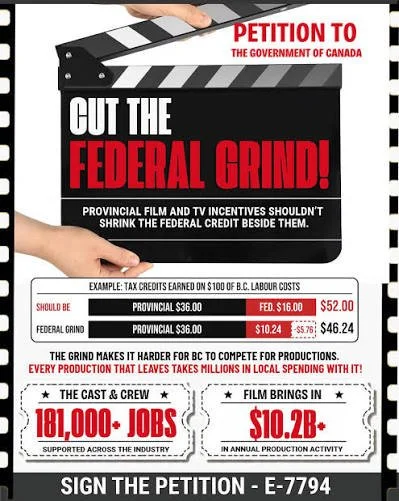
IATSE Local 891 has launched a national petition calling for the elimination of the federal grind. The campaign is intended to bring more productions and jobs to Canada, support additional Canadian content development, and strengthen the country’s competitiveness as a production jurisdiction. The petition is sponsored by Burnaby Central MP Wade Chang.
The federal grind can sound like an obscure tax-policy issue, but the way federal and provincial incentives interact affects the value of production tax credits and ultimately the financing calculations behind where projects are produced.
If you support the proposal, add your name and share the petition with your network.
Support Keep Ontario Rolling
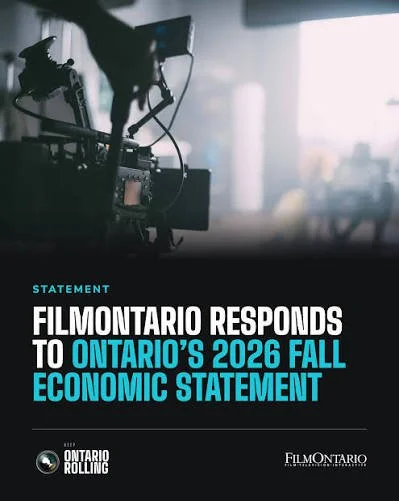
FilmOntario’s Keep Ontario Rolling campaign has called for measures intended to strengthen production and support Canadian-owned projects in Ontario, including increasing the Ontario Production Services Tax Credit from 21.5% to 25%, increasing the Ontario Film and Television Tax Credit from 35% to 40%, and investing an additional $26 million in the Ontario Creates IP Fund for linear content.
Those numbers can sound abstract, but the principle is straightforward: strong and predictable production incentives help support employment and investment, while funding for Canadian intellectual property can help domestic projects assemble the financing they need to move forward.
Ontario is one part of a much larger national production ecosystem. Similar conversations about incentives, domestic production, workforce development, infrastructure, and long-term industry stability are happening in jurisdictions across the country. The goal should not be to pit one Canadian region against another, but to ensure Canada as a whole remains a strong place to finance, create, and produce film and television.
The City of Toronto’s adopted Screen Future strategy reflects that same broader direction, with priorities around production capacity, incentives, workforce development, sustainability, and stronger support for domestic production.
Add Your Voice to Canadian Stories. Global Impact.
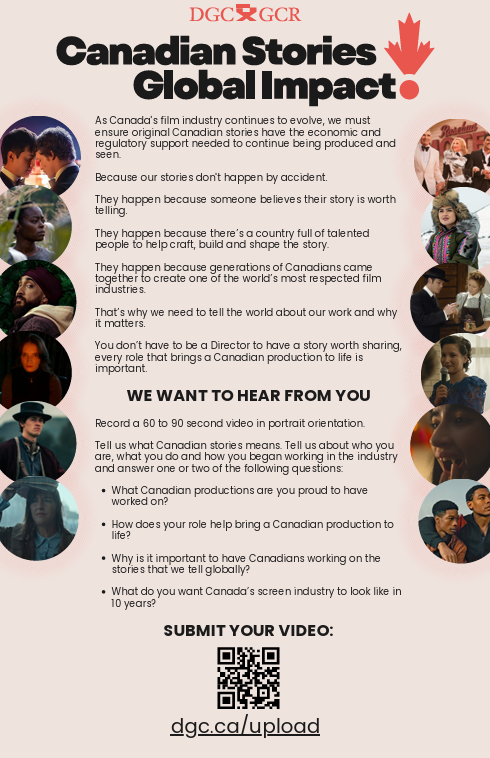
DGC National’s Canadian Stories. Global Impact. campaign is inviting members from departments and regions across the country to talk about why their work matters and why investment in Canadian storytelling matters.
The CPD particularly encourages production designers, art directors, set decorators, and other art department members of the DGC to participate.
Our departments are responsible for an enormous part of what audiences actually see on screen. When the industry is demonstrating the cultural and economic impact of Canadian production, the people who design and create those worlds should be part of that story too.
Canadian projects need financing and investment to move from development into production. When a project is greenlit, that investment reaches far beyond the people whose names appear above the title. It supports art departments, construction, scenic, props, costumes, locations, transportation, studios, rental houses, suppliers, vendors, and thousands of other workers and businesses.
If the industry is making the case for Canadian stories, our art departments should help tell it.
If You Want Change, Participate
It is easy to feel frustrated by the current state of the industry. Turning that frustration into action is more useful.
These campaigns address different parts of a complicated system, but they are part of a much wider and increasingly coordinated effort to strengthen Canada’s screen sector. The CPD stands alongside the unions, guilds, nonprofits, producers, industry associations, film offices, and other organizations doing this work.
We are also beginning our own direct advocacy. The CPD is working to meet with elected representatives, share the experiences of the people we represent, and make the case for policies that support production, Canadian storytelling, sustainable careers, and a strong national screen industry.
Our intention is not to duplicate the work already being done. It is to add our voice to it, support the priorities we share, and make sure production design and the art department are represented within those conversations.
That effort is stronger when individuals participate too.
Write the letter. Sign the petition if you support it. Participate in the campaign. Record the video. Share the information with someone who may not know these efforts are underway.
If we want more productions made in Canada, more Canadian projects greenlit, and more people working consistently, the people making decisions need to understand both the value of this industry and what is at stake.
The CPD will continue advocating directly, working alongside our industry colleagues, and sharing practical opportunities for our community to add its voice.
